


A steering wheel that suddenly shakes can make even a familiar commute feel uncertain. To diagnose steering vibration safely, focus first on when it happens, how severe it feels, and whether any warning signs point to an immediate safety issue. You do not need to take risks on a busy road or start replacing parts based on a guess.
A vibration may come from something as routine as wheel balance, but it can also involve a damaged tire, loose wheel hardware, worn suspension parts, or brake concerns. The goal is to notice the pattern, perform a few safe visual checks, and get professional help before a small issue affects handling, tire life, or stopping performance.
Start With a Safety Check
Before trying to identify the cause, decide whether the vehicle should be driven at all. Pull over in a safe location and arrange service rather than continuing your trip if the steering wheel shakes violently, the vehicle pulls hard, you hear loud clunking or grinding, or a tire looks low, damaged, or misshapen.
You should also stop driving if a tire pressure warning light appears with the vibration, if the vehicle feels unstable in turns, or if the brake pedal pulsates heavily. A sudden change in steering feel is not something to test repeatedly at highway speed. Keeping the vehicle under control and avoiding additional tire or suspension damage matters more than narrowing down the diagnosis yourself.
If the vibration is mild and the vehicle otherwise tracks straight, begin with a calm observation during normal, legal driving. Note the speed, road surface, and driving action that causes it. Those details can save time in the repair bay and help a technician find the actual source faster.
When Does the Steering Vibration Happen?
The timing of the vibration is one of the most useful clues. Steering vibration at a certain speed often has a different cause than vibration that appears only while braking or turning.
Vibration at highway speeds
A shake that starts around moderate or highway speeds, then reduces as you slow down, frequently points to a tire or wheel issue. An out-of-balance wheel is a common cause. Even a small amount of missing wheel weight can create a noticeable shake through the steering wheel, especially in the 50 to 75 mph range.
A bent wheel, uneven tire wear, tire separation, or a tire that is not perfectly round can create a similar symptom. Potholes, rough pavement, and curb contact can all damage a wheel or tire without causing an immediate flat. This is particularly common after winter driving, when potholes can be difficult to avoid.
Vibration while braking
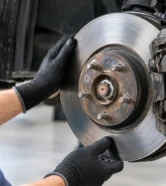
If the steering wheel shakes mainly when you apply the brakes, the brake system deserves attention. Brake rotor thickness variation, rotor runout, sticking calipers, or worn suspension components can produce a pulsation that travels into the steering wheel.
Drivers often describe this as a wobble that becomes stronger during harder braking. Do not assume new brake pads alone will correct it. A proper brake inspection should include the rotors, calipers, pads, hardware, wheel bearings, and the steering and suspension parts that keep the front wheels stable under braking.
Vibration while accelerating
A vibration that appears during acceleration but fades when you let off the gas can be related to drivetrain components, engine or transmission mounts, or inner CV joints on many front-wheel-drive and all-wheel-drive vehicles. It may not always be felt primarily in the steering wheel, but it can travel through the floor, seat, and wheel.
This symptom needs a professional inspection because the cause is not always visible from outside the vehicle. Continuing to drive with a failing drivetrain component can lead to more expensive repairs and unreliable performance.
Vibration during turns
Shaking, knocking, or a loose feeling while turning can point to steering or suspension wear. Tie rod ends, ball joints, control arm bushings, strut mounts, and wheel bearings all play a role in keeping the wheels pointed where you intend.
If a vibration comes with clicking during tight turns, especially while accelerating, a CV joint may be involved. If the steering feels vague, wanders across the lane, or requires frequent correction, schedule an inspection promptly rather than relying on an alignment alone.
Safe Checks You Can Make at Home
A few simple checks can provide useful information without putting you underneath the vehicle or asking you to work around moving parts. Park on level ground, set the parking brake, and inspect the vehicle in good lighting.
Start with tire pressure. Check all four tires when they are cold and compare the readings with the pressure listed on the driver-side door placard, not the maximum pressure printed on the tire sidewall. Low pressure can worsen vibration, reduce handling control, and cause damaging heat buildup.
Then look carefully at each tire. Watch for bulges, cuts, cracks, exposed cord, nails, uneven tread wear, or sections of tread that appear raised or wavy. Run your hand lightly across the tread surface only after the vehicle has been parked and the tires are cool. Cupped or scalloped wear can feel uneven and may indicate a balance, alignment, or suspension problem.
Inspect the wheels for obvious bends, cracks, or missing wheel weights. A clean rectangular outline where a wheel weight was once attached is worth mentioning during service. Do not try to straighten a wheel yourself or use sealant as a solution for a damaged tire.
Finally, look at the wheel lug nuts. If one is visibly missing, loose, or different from the others, do not drive the vehicle. Wheel installation should be completed with the correct hardware and torque specification. Over-tightening is not safer, and uneven torque can contribute to brake rotor problems.
Why Wheel Balance and Alignment Are Different
Wheel balance and wheel alignment are often discussed together, but they correct different problems. Balancing distributes weight evenly around the tire and wheel assembly. It is the service most commonly associated with a speed-specific steering vibration.
Alignment sets the angles of the wheels so the vehicle tracks straight and tires meet the road correctly. Poor alignment more often causes pulling, an off-center steering wheel, or uneven tire wear. It can contribute to a vibration by wearing tires unevenly, but an alignment alone will not fix an out-of-balance wheel or a damaged tire.
The right repair depends on inspection results. A technician may recommend balancing, tire rotation, wheel repair, alignment, suspension repair, or a combination of services. Honest diagnostics mean fixing the cause, not selling a service that does not match the symptom.
Avoid These Common Mistakes
When trying to diagnose steering vibration safely, avoid “testing” the problem by driving faster to see how bad it gets. High speeds reduce your margin for error, particularly if a tire has internal damage or a wheel is loose.
Do not ignore a vibration because it comes and goes. Road conditions and vehicle speed can mask the issue temporarily, while tire wear or a worn component continues to worsen. Avoid rotating a visibly damaged tire to another position as well. Rotation is a maintenance service, not a repair for tire defects.
It is also wise not to assume the last service caused the problem, although timing is worth mentioning. If vibration began after new tires, wheel service, brake work, or a pothole impact, tell the technician exactly when you first noticed it. That history helps guide a precise inspection.
What Professional Diagnostics Should Include
A thorough inspection begins with a road test only when it is safe to do so, followed by checks of tires, wheels, brake components, wheel bearings, steering linkage, and suspension. Technicians may measure wheel runout, inspect tire condition closely, verify wheel balance, and check for play in components such as tie rods and ball joints.
For brake-related vibration, proper diagnostics can include measuring rotor condition and checking caliper operation rather than simply replacing parts. For persistent or unusual shakes, technicians may also inspect axle shafts, CV joints, mounts, and driveline components.
At JAK Tire Service, the focus is on clear answers and practical repairs, whether the fix is a straightforward wheel balance or a more detailed steering, brake, or suspension repair. A good shop should explain what was found, why it matters, and what work is recommended now versus what can be monitored.
A smooth steering wheel is more than a comfort feature. It helps you feel what your vehicle is doing and drive with confidence. If the vibration is new, getting stronger, or paired with braking, tire, or handling concerns, arrange an inspection soon and give yourself the benefit of a safer, steadier drive.